


Introduction to Mine Reconciliation
Mine reconciliation allows mine operators to seek out improvement opportunities, potentially increasing revenue and reducing costs by millions.
When cash burn rates at mining operations are $10M+ per month, even a 1% cost reduction or improvement in productivity has a huge impact on the bottom-line. Proper mine reconciliation processes provide the base for mine operators to seek out these opportunities.
What is Reconciliation?
According to a 2009 presentation by Chris Bray of SRK: reconciliation is the “comparison of estimated tonnes, grade and metal against actual measurements”. Examples of these estimates include public disclosures such as resources and reserves and production guidance plans. Actual measurements consist of reported production as well as internal figures such as the pit and stope designs, raw conveyor tonnages, and skip counts.
To explain the concept of reconciliation, let’s go to the Minebright Gold Mine, a small underground operation with a ROM ore stockpile and a conventional CIL plant.
Last week, the mine blasted a stope in a series of firings and Bob worked hard to haul all the ore to the ROM pad. How many tonnes of ore did he transport? How much metal was contained in that ore? The answer might depend on who you ask and the information that was available to them:
Model estimates:
- Resource model: 20,000t @ 10.00g/t (6,430 ounces contained)
- Grade control model: 21,000t @ 9.50g/t (6,413 oz)
- Reserve model: 22,000t @ 9.00g/t (6,365 oz)
- Final stope design: 18,000t @ 11.00g/t (6,365 oz)
Operational measures:
- Truck factor: 24,000t
- Plant crushed: 21,000t @ 8.50g/t (5,738 oz)
- Sold metal: 21,000t @ 8.65g/t (5,840 oz)
Survey measures:
- Stope CMS: 11,000m3
- ROM stockpile surveys: 15,000m3
Even at this simple operation, there are at least eight different estimates and measurement points regarding how much material Bob hauled to surface, and how much metal was included. Understanding, tracking, and reporting the estimates and measurements of tonnes and grade throughout the journey the ore takes from the resource model to the sold metal informs mining professionals about their operation. This is where the Pit Info software brings value. For example:
- Truck factor – plant crushed: the truck factor and trip count claimed 24,000 tonnes, but the plant crushed was only 21,000 tonnes. After accounting for changes in stockpile balances, this may indicate underfilling of trucks. The engineers should verify that loading procedures are being followed.
- Final stope design – sold metal: the engineers designed a stope with 18,000 tonnes containing 6.4koz of metal. However, 21,000tonnes of material was extracted from the stope containing only 5.8koz of metal. Could this be indicative of significant ore loss and dilution during blasting? Was the floor over dug?
- Reserve model – sold metal: the reserve model had more tonnes and a higher grade than the final reconciled values. Is the reserve model overly optimistic? Guidance is based on the reserve model, should it be revised/
How is Mine Reconciliation Calculated?
Calculating mine reconciliation is worthy of a post (or a series of posts) of its own. In this section we’ll explain how reconciled ore tonnes are calculated.
The screen shot below is taken from Minebright’s Pit Info reconciliation software. We see a user is calculating the reconciled ore tonnes for the period by uploading a stockpile survey. In this example, 42,749 ore tonnes were claimed to be mined from Pit 1 and 41,952 tonnes from Pit 2 since the last survey was uploaded, for a total of 84,600 tonnes.
‘Claimed’ tonnes are raw values that come from either counting trips and using a truck factor, or from a fleet-management system and on-board sensors. They are not the final reported (reconciled) values and serve to track production during the month when better data doesn’t exist.
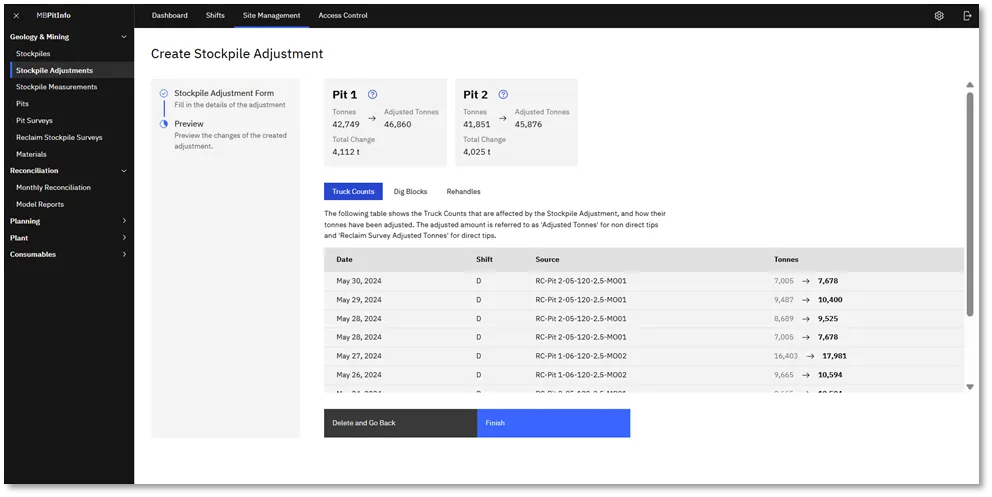
Screen shot from Minebright’s Pit Info application
Reconciled ore tonnes mined for the period are calculated as follows:

Although the ‘reconciled ore tonnes mined’ are treated as the actual, it’s also based on assumptions and estimates:
- Assume zero error with the stockpile and coarse ore stockpile surveys
- Assume zero error with the mill weightometer
- Assume that loose densities for all the stockpiles are correct
The total ‘reconciled ore tonnes mined’ for the period in this example was calculated to be 92,736 tonnes. The ‘claimed mined to reconciled mined’ tonnes call factor for the period is:

The ‘reconciled ore tonnes mined’ was 10% greater than the original claim. The ‘claimed ore tonnes mined’ for each ore source will be multiplied by 110% to calculate the ‘reconciled ore tonnes mined’. However, ff there is strong evidence that one ore source had a poor density estimation (for example) then the variance between the claimed and actual can be attributed to that ore source. There should be a compelling argument for not attributing a broad call factor for all ore sources, especially in cases where there are different royalty agreements for the operation’s ore sources.
Why Does it Matter?
Mine reconciliation provides the essential feedback that keeps a mining operation aligned with its geological predictions and financial targets. By comparing estimated tonnes, grades and metal content against actual measurements, companies can confirm whether their reserve and resource models accurately reflect the orebody as it will be mined by their operation. This validation process not only builds confidence in future mine plans but also helps refine geological interpretations as more production data becomes available.
Identifying where ore loss or unplanned dilution occurs yields immediate operational benefits. When reconciliation highlights discrepancies between planned and actual production, engineers and geologists can investigate whether material is being misclassified at the face, lost during haulage or diverted in stockpiles. Pinpointing these issues enables targeted interventions, such as adjusting blasting protocols, improving shovel loading techniques or refining grade control sampling, that deliver significant cost savings on high-value activities.
Financial forecasting and investor relations depend on reliable guidance. Reconciliation data turns speculative forecasts into evidence-based projections, bolstering credibility with stakeholders. Early detection of variance reduces the risk of budget overruns and schedule delays by bringing attention to problems before they escalate. Continuous improvement frameworks such as DMAIC (Define Measure Analyze Improve Control) or PDCA (Plan Do Check Act) rely on measured feedback loops, and reconciliation provides the measurable insights that drive each cycle.
Beyond internal efficiency, reconciliation underpins transparent reporting for regulators and investors concerned with environmental, social and governance standards (especially considering the proposed changes to JORC potentially coming this year). Demonstrating control over material and metallurgical balances shows that a company is managing its resources responsibly and meeting its production commitments. In an industry where even small percentage gains translate into millions of dollars at the plant gate, proper reconciliation processes should be the norm.
Closing Thoughts
Reconciliation is a complicated process that involves departments across the operation, one of the many reasons that make it so challenging to properly implement. Minebright’s Pit Info platform is a web-based production database and reconciliation software that provides certainty, auditability, and actionable insights when it comes to reconciliation and production reporting. The applicability and advantages of using the Minebright Pit Info platform for mine reconciliation purposes will be expanded on in future posts. Reach out to us at info@minebright.com or take a look at some of the product videos on Minebright’s Youtube, if you’d like to learn more.