


Mine Reconciliation: A (simplified) Step-By-Step Guide
Reconciliation is complex in practice, but can be broken down into a simple series of calculations.
In the previous introductory post, we went over the what, why, and (briefly) the how of mine reconciliation. In this post we will dive deeper into the ‘how’ of mine reconciliation using data from a gold mine that has been modified to maintain anonymity. In this article, and all following, the terms “mine reconciliation” and “mine-to-mill reconciliation” will be used interchangeably.
Mine-to-mill reconciliation is the process of taking estimates and modeled values and transforming them into reported values. Besides the operational benefits of analyzing your reconciliation, discussed in the previous post, reporting of production figures is the other obvious use case for mine-to-mill reconciliation.
Here we’ll assume that the processing plant already has prepared their reconciliation. We will cover mill reconciliation in a future article.
What are claimed production values?
‘Claimed’ (estimated) production values are tracked during the month and are largely used for internal reporting. Mine-to-mill reconciliation is the process of calculating ‘actual’ (reconciled) values from ‘claimed’. Production figures from the processing plant and stockpile surveys are treated as ‘actual’ and most other values as ‘claimed’. Mine-to-mill reconciliation becomes an exercise in ensuring that the mine’s values match (reconcile) what the plant has reported.
For production figures to be reconciled, the following equation must be true, both for tonnes and contained metal:

As an example, consider the following claimed values over an unspecified period:
- Ore Mined: 10,000 tonnes claimed by the mine
- Change in stockpile: 5,000 tonnes
- Plant Feed: 10,000 tonnes
Note that the change in stockpile tonnage is typically based on a change in size of the stockpile volume, which is then converted into a tonnage using a bulk density factor.
If the figures above were used for financial reporting, the operation would report (claim) that they mined and milled the same number of tonnes but it is evident that stockpiles grew by 5,000 tonnes. That’s physically impossible, hence the need for reconciling the mine values to the processing plant.
How do you calculate claimed values?
Claimed Mined
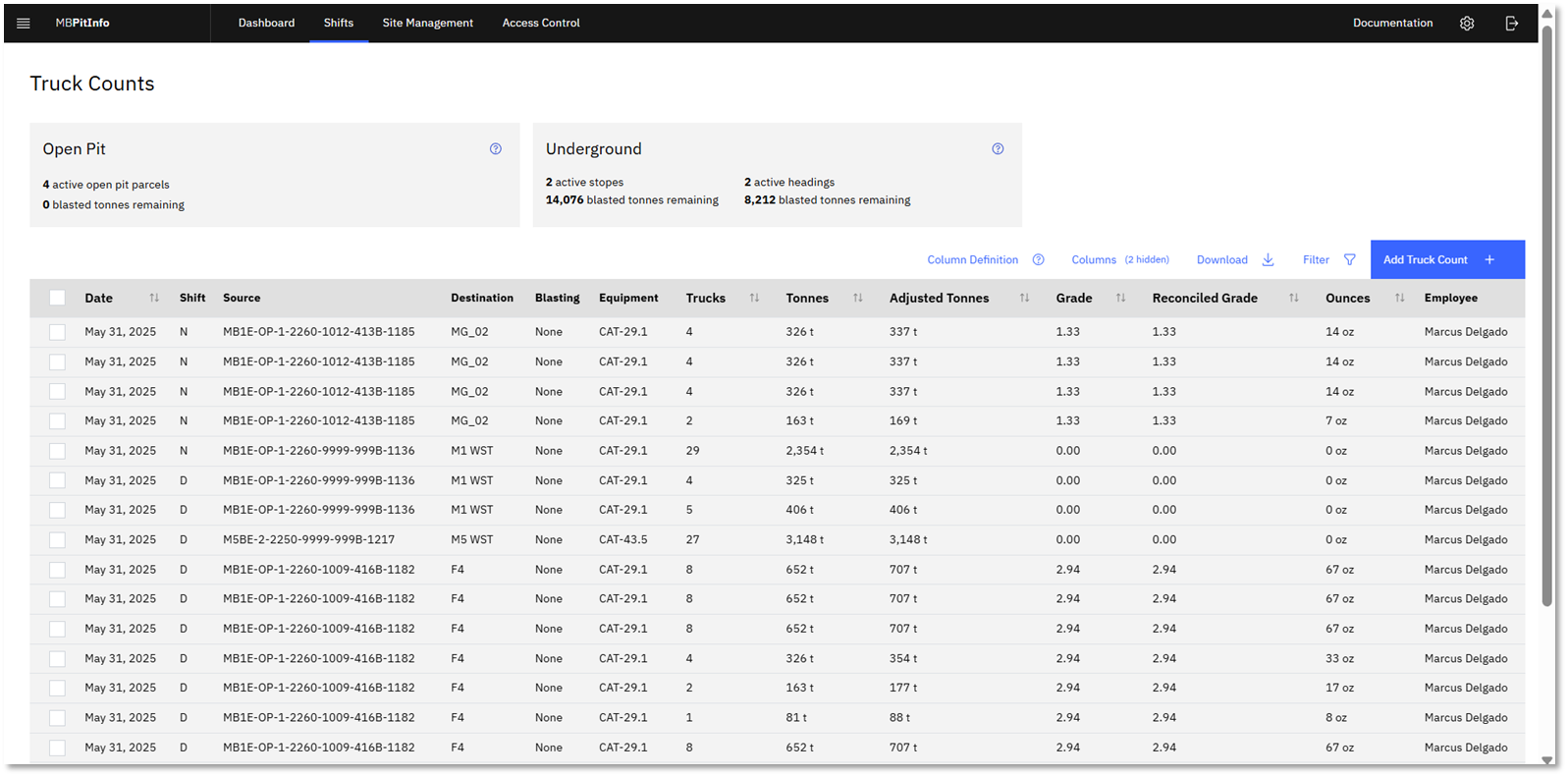
Tonnes: claimed mined tonnes are collected throughout the month in ‘real-time’ or ‘near real-time’ depending on whether the data is collected on PLODS or from a fleet management system. At a minimum, the following data will be collected:
- Date
- Shift
- Source (dig block, stope, development heading)
- Destination (stockpile)
- Number of trips or truckloads
The image below is from a screen shot of Pit Info, Minebright’s production tracking and reconciliation software.
In the absence of a fleet management system that monitors truck payloads, claimed tonnes are calculated with the following formula:

Truck factors are values that estimate how many tonnes (or m3) of material can be hauled in one trip on average. Truck factors will vary by equipment model and perhaps material type and are important to understand correctly. Hence, they can also be a source of error.
Grade and Metal: grade estimates are provided by the mine engineers who enter the dig blocks. In cases where the dig block / stope has been overmined, the grade of the claimed mined will not equal the in-situ grade. In Pit Info, users can assign ‘grade of dilution’, which is a grade that will be assigned to any over mining. The default ‘grade of dilution’ is 0, however in many instances the diluting material may consist of low grade.
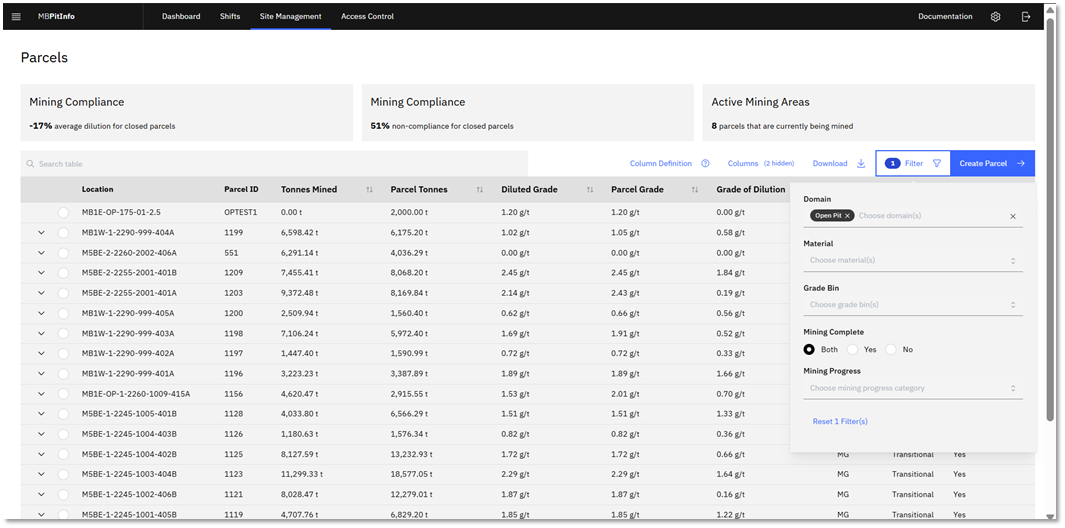
The claimed mined metal is the mined tonnes times the mined (diluted) grade.
Claimed Crushed
Grade and Metal: both the Processing Plant and Geology will report a ‘claimed crushed grade’. The processing plant crushed grade ismeasured from composite sampling or from instrumentation installed on the conveyor.
Geology’s crushed grade is based on the sources of the fed material. If Geology claims, based on the loader trips, that 45% of the crushed material was from SP-Green, 25% from SP-Red, and 30% from SP-Blue, those proportions are applied to the plant’s crushed tonnes to calculate the claimed tonnes crushed by stockpile.
The ‘claimed grade’ fed from each stockpile depends on the feeding strategy assigned to the stockpile. The three feeding strategies are:
- First-in-first-out (FIFO)
- Last-in-first-out (FIFO)
- Average
Feeding strategy is decided by Geology and is often decided by stockpile geometry, and whether the stockpile will be fed within the year.
Tonnes: in the screen shot below from Pit Info, the ‘Tonnes’ column is based on the number of trips and the loader factor and ‘Adjusted Tonnes’ is the value factored by the mill’s dry crushed tonnes, measured from the conveyor weightometer and adjusted for moisture.
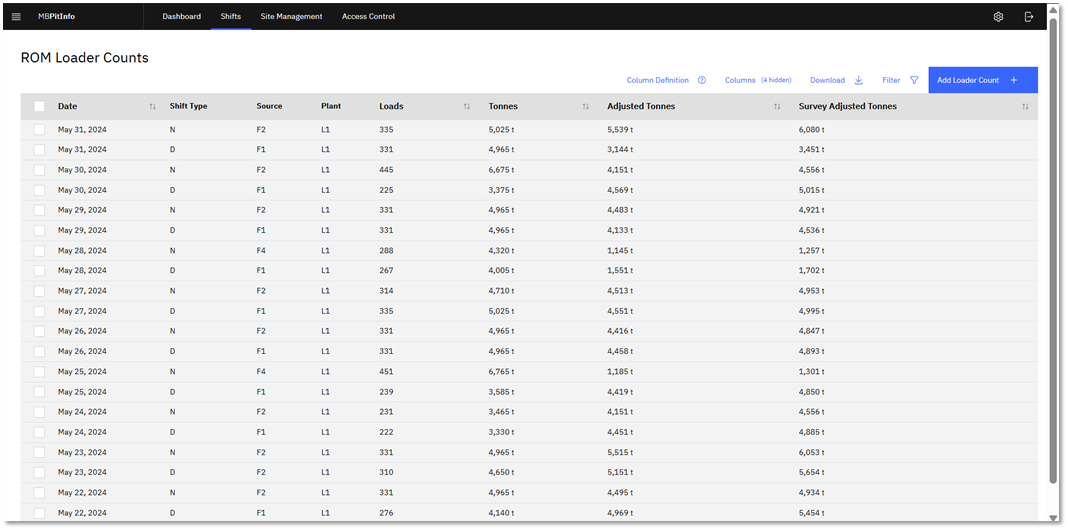
In Pit Info, a ledger of all transactions is maintained so that calculating crushed grade no matter the feeding strategy is automatically calculated.
Claimed Stockpile Balance
The ‘claimed stockpile balance’ is calculated by taking the previous period’s reconciled stockpile balance and adding the inflows (ore mined) and subtracting the outflows (crusher feed). The formula is specifically:

How do you calculate reconciled values?
Reconciled values are typically calculated at the end of the month but volumetric surveys throughout the month are common and will lead to reconciled tonnes while metal will be calculated at end of month (EOM).
Reconciled Crushed
With no coarse ore stockpile (COS) after crushing, the reconciled crushed tonnes and metal would be equal to the milled. When there is a COS, the formula for reconciled crushed metal and tonnes is:

Milled tonnes and metal come directly from the Plant.
Tonnes: in the Pit Info screenshot below, we see the crusher feeds in a data table with three columns for tonnes: “Tonnes”, “Conveyor Adjusted Tonnes”, and “Reconciled Tonnes”. Each column is calculated as follows:
- Tonnes: the loads multiplied by the loader factor.
- Conveyor Adjusted Tonnes: the “Tonnes” are factored so that the total for the shift equals the dry crushed tonnes measured in the plant.
- Reconciled Tonnes: using the reconciled crushed tonnes formula above, using the COS survey and the milled tonnes.
At end of month, there will be a survey of the COS. A loose density will be applied to calculate the tonnes. This loose density could either be calculated based on the proportion of stockpiles fed during the period and their respective loose densities, assigned a fixed value, or measured periodically.
Grade and Metal: the grade of the COS will be assigned the average claimed crushed grade for the period. It may seem counterintuitive using an unadjusted claimed value as a reconciled grade, the alternative creates a circular dependency. Because the reconciled crushed grade calculation itself relies on the COS grade, we must ‘break the loop’ by applying the claimed crushed grade. While this approach may introduce minor errors, the discrepancy is generally negligible compared to the total metal milled.
Reconciled Stockpile Balance
Tonnes: calculating the reconciled tonnes in a stockpile requires a surveyed volume and a loose bulk density. The loose density will either be calculated based on the theoretical composition of the stockpile or given as an input. Some operations may periodically conduct experiments to measure loose density, while others will use fixed values that are deemed ”good enough”.
Grade and Metal: reconciled stockpile contained metal is calculated with the following formula:

Reconciled Ore Mined
As stated before, the equation for reconciled ore mined is:
Tonnes: in the Pit Info screenshot below, we see a stockpile adjustment (survey) for the F5 stockpile. The claimed tonnes mined for all mined material that was delivered to F5 is factored to ensure that the ‘reconciled ore tonnes mined’ equals the new (reconciled) stockpile balance + the plant feed.
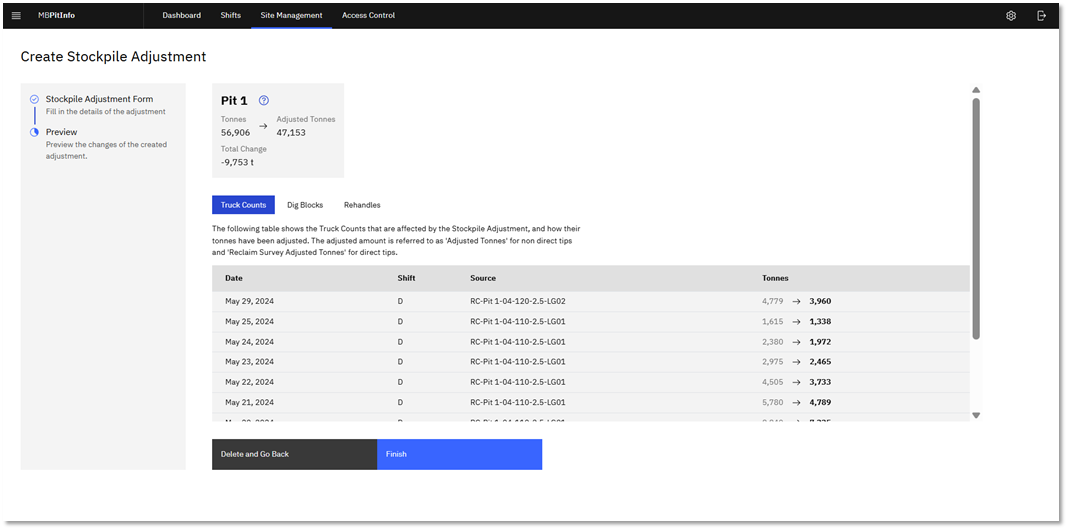
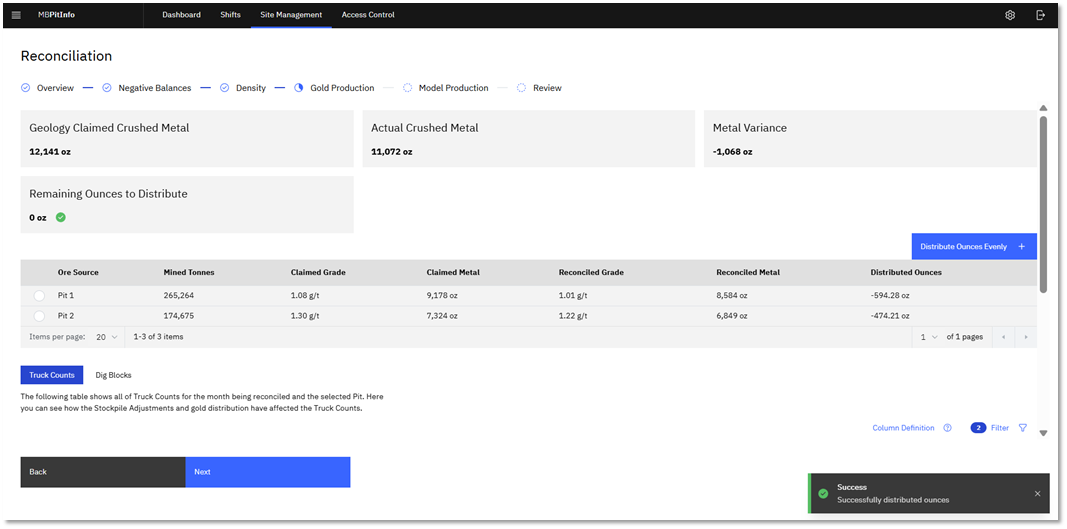
Grade and Metal: the variance between the ‘claimed metal mined’ and the ‘reconciled metal mined’ is distributed to each mining transaction based on the relative weights of the ‘claimed metal mined’. Below, we see that there was a negative variance for the month that was distributed to the two ore sources. The negative variance is reflected in the ‘grade’ column where we see the claimed grade and the lower reconciled grade.
Closing Thoughts
Mine reconciliation can seem daunting but reconciled values can be boiled down to four formulas:

The art and science of mine reconciliation is how geologists, engineers, and metallurgists manage and interrogate the assumptions (loose densities, survey errors, weightometer miscalibrations) that form the basis of their reconciliation but can also draw conclusions from the various calculated call factors in the context of their operation.
The steps described here are not the only way to reconcile mine production. While flexibility ensures that practitioners can fine-tune their reconciliation processes to match their operation, it also leaves open opportunities for errors and misunderstandings of procedures, especially when there’s turnover with key personnel. Pit Info has built in audit trails and extensive documentation, to ensure that all stakeholders are aware of and adhere to the operation’s reconciliation procedures.
Another step in mine reconciliation not discussed in this post is the comparison of resource model versus reserve model vs grade control model, which will be covered in a future post and is possible in Pit Info.
Reach out to the Minebright team at info@minebright.com if you wish to learn more about Pit Info, standardizing reconciliation processes, the value in understanding the various call factors, or have a suggestion for a future post.